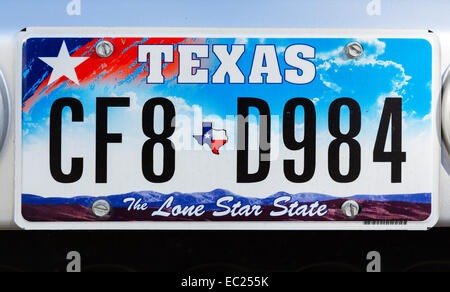
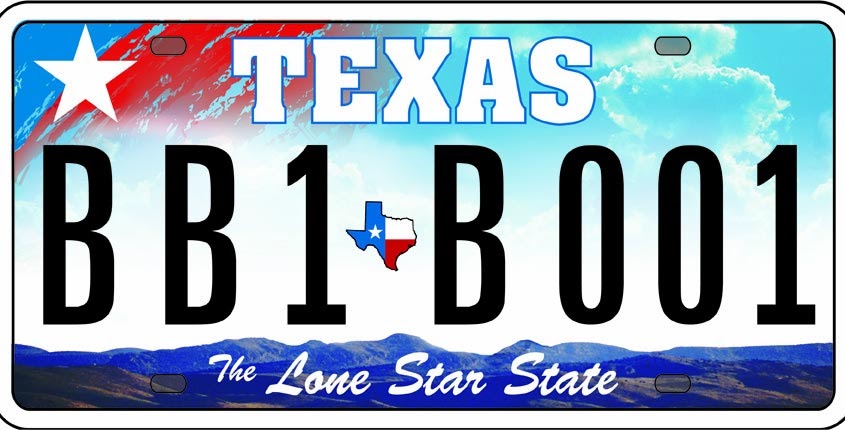
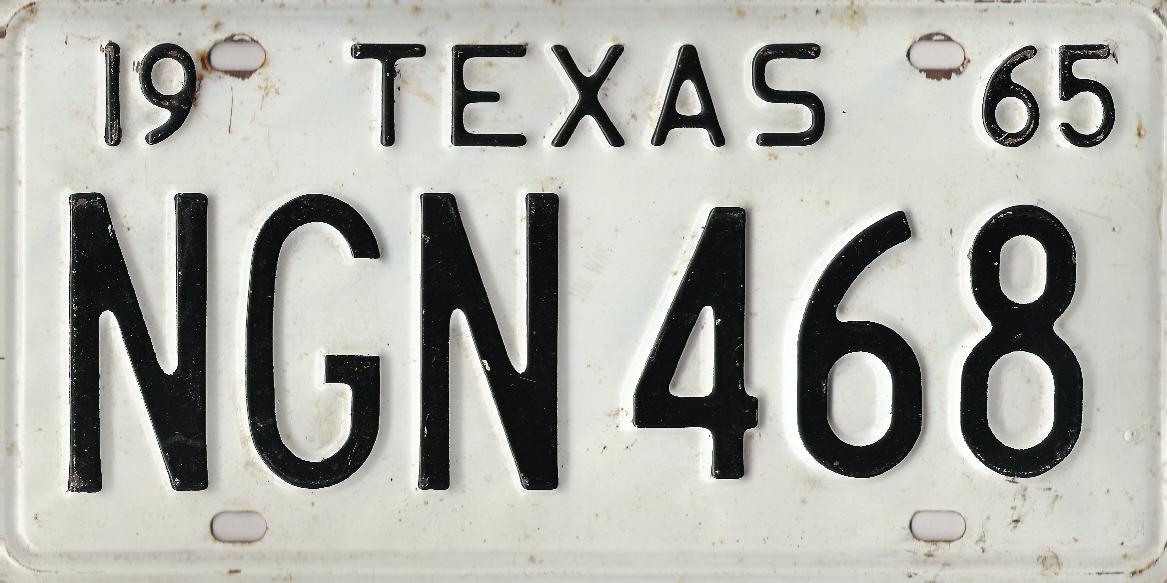
The U.S. state of Texas first required its residents to register their motor vehicles in 1907. Registrants provided their own license plates for display, with serial numbers assigned by their county of residence, until the state began to issue plates in 1917.
As of 2024, plates are manufactured at the Wynne Unit in Huntsville, Texas, and are issued by the Texas Department of Motor Vehicles (TxDMV). Front and rear plates are required for most classes of vehicles, while only rear plates are required for motorcycles, trailers and antique vehicles.
Passenger baseplates
1917 to 1974
In 1956, the United States, Canada, and Mexico came to an agreement with the American Association of Motor Vehicle Administrators, the Automobile Manufacturers Association and the National Safety Council that standardized the size for license plates for vehicles (except those for motorcycles) at 6 inches (15 cm) in height by 12 inches (30 cm) in width, with standardized mounting holes. The first Texas license plate that complied with these standards was a modification of the 1955 plate, introduced towards the end of that year.
1975 to present
Non-passenger plates
Temporary tags
Temporary tags are issued to unregistered vehicles and to vehicles registered in states that do not have a reciprocity agreement with Texas. These tags are printed on paper and are used mainly by dealers. As of 2022, four types are available: three are valid for 72 hours, 144 hours, and 30 days respectively; the fourth is the "one-trip" tag, which is issued only to unladen vehicles traveling from a single origin to a single destination (either of which must be in Texas) and is valid for 15 days.
In February 2022, it was reported that as many as 1.2 million fraudulent temporary Texas tags were sold in the United States in 2021. Due to inadequate security standards in the dealer application process in Texas, fraudulent individuals posing as dealers could purchase licenses for less than $800. This gave them access to the Texas DMV database, which they could use to print temporary tags and sell them online for profit. Most drivers who purchased the tags did so to make their vehicles untraceable when committing crimes, or to avoid paying tolls and registration fees.
Optional plates
Texas has more specialty plates than any other state, with 506 available.
References
Further reading
- The History of Texas License Plates – 80th Anniversary Edition (PDF). Austin, Texas: Texas Department of Transportation. March 1999. Archived (PDF) from the original on 28 October 2012. Retrieved 16 March 2024. An extensive history and catalog of Texas license plates.
External links
- Texas license plates, 1969–present